Publicado: Mar Ene 02, 2007 10:27 am
HS 293

Bomba planeadora guiada por radio, capaz de llevar una cabeza de 500 kg. de explosivo. En el curso de la contienda hundió muchas unidades enemigas y fue también provechosamente empleada contra objetivos de tierra firme.

Hs-293 Version A

Sistema de propulsión Walter 109-507 para el Hs-293
Technical specifications for Hs-293 series: (169)
Length 3.82 meters
Span 3.10 meters
Launch weight 1,045 kilograms
Flight range 18 kilometers (from the aircraft to the target)
Warhead weight 295 kilograms of high explosive
Propulsion system thrust 590 kilograms (Walter 109-507 B)
Propellant Hydrogen peroxide and watery solution of sodium or calcium
Fuentes texto: "La Segunda Guerra Mundial" Edic. Sarpe Vol. 5 página 1629
Fuente fotos y datos técnicos: http://www.russianspaceweb.com/hs293.html
HS 294
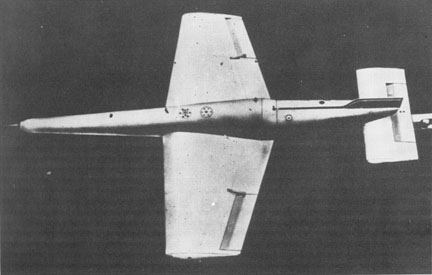
Bomba planeradora similar a la anterior, pero de mayores dimensiones; en el último segmento de su trayectoria radiodirigida soltaba las alas y se sumergía en el mar como un torpedo. Un sensor acústico colocado en la cabeza la dirigía luego automáticamente hacia la nave de blanco.
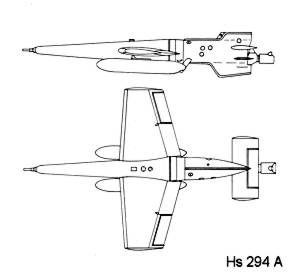
Manufacturer: Henschel
Type: Air launched guided glide torpedo bomb
First Launch: 1941
Dimensions:
Fuselage Diameter: 620mm
Length: 6114mm
Weight: 2170 kg.
Propulsion Unit: 2 x HWK 109-507D
Fuel Weight: N/A
Thrust (kiloponds): 1,300
Explosive Weight: 630kg
Wing Span: 4025mm
Wing Area: 5.30 Cubic Meters
Targeting:
Hs 294D - Television guidance from launch plane.
Number Produced:
20 Hs 294 V1
40 to 80 Hs 294 A-0
45 Hs 294 V2
20 Hs 294 D
Fuentes texto: "La Segunda Guerra Mundial" Edic. Sarpe Vol. 5 página 1629
Fuentes imágenes y datos técnicos: http://www.warbirdsresourcegroup.org/LRG/hs294.html
HS 295
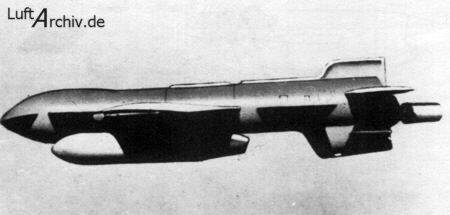
Misil antinavío que debía lanzarse desde un bombardero. El proyecto fue abandonado poco despues del comienzo de la producción.
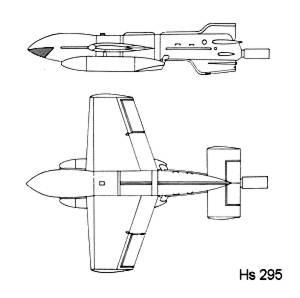
Stage: Prototype for aerodynamic tests
Structure: Steel covered by aluminum
Wings and Tail Unit: Aluminum structure and coating. Movable surfaces actuated by electrical controls.
Power plant: Two Walter 109-507 D with a joint thrust of 1,300 kg (2,860 lb.)
Propellant: T-Stoff and Z-Stoff
Pressurizer: Compressed air
Warhead: 585 kg (1,443 lb. of H.E.)
Launch weight: 2,090 kg (4,598 lb.)
Guidance: Passive radar receiver
Length: 5.44 m (17 ft. 10 1/8 in.)
Span: 4.08 m (13 ft. 4 1/2 in.)
Maximum Diameter: 0.58 m (1 ft. 10 4/5 in.)
Maximum speed: 235 m/s (770 ft./sec.)
Range: 4-14 km at 500 - 8000 m altitude
Fuente texto: "La Segunda Guerra Mundial" Edic. Sarpe Vol. 5 página 1629
Fuente imágenes: http://www.lietadla.com/vyzbroj/hs-293.htm
Fuente datos técnicos: http://www.ww2guide.com/missiles.shtml
Continuará...
Bomba planeadora guiada por radio, capaz de llevar una cabeza de 500 kg. de explosivo. En el curso de la contienda hundió muchas unidades enemigas y fue también provechosamente empleada contra objetivos de tierra firme.
Hs-293 Version A
Sistema de propulsión Walter 109-507 para el Hs-293
Technical specifications for Hs-293 series: (169)
Length 3.82 meters
Span 3.10 meters
Launch weight 1,045 kilograms
Flight range 18 kilometers (from the aircraft to the target)
Warhead weight 295 kilograms of high explosive
Propulsion system thrust 590 kilograms (Walter 109-507 B)
Propellant Hydrogen peroxide and watery solution of sodium or calcium
Fuentes texto: "La Segunda Guerra Mundial" Edic. Sarpe Vol. 5 página 1629
Fuente fotos y datos técnicos: http://www.russianspaceweb.com/hs293.html
HS 294
Bomba planeradora similar a la anterior, pero de mayores dimensiones; en el último segmento de su trayectoria radiodirigida soltaba las alas y se sumergía en el mar como un torpedo. Un sensor acústico colocado en la cabeza la dirigía luego automáticamente hacia la nave de blanco.
Manufacturer: Henschel
Type: Air launched guided glide torpedo bomb
First Launch: 1941
Dimensions:
Fuselage Diameter: 620mm
Length: 6114mm
Weight: 2170 kg.
Propulsion Unit: 2 x HWK 109-507D
Fuel Weight: N/A
Thrust (kiloponds): 1,300
Explosive Weight: 630kg
Wing Span: 4025mm
Wing Area: 5.30 Cubic Meters
Targeting:
Hs 294D - Television guidance from launch plane.
Number Produced:
20 Hs 294 V1
40 to 80 Hs 294 A-0
45 Hs 294 V2
20 Hs 294 D
Fuentes texto: "La Segunda Guerra Mundial" Edic. Sarpe Vol. 5 página 1629
Fuentes imágenes y datos técnicos: http://www.warbirdsresourcegroup.org/LRG/hs294.html
HS 295
Misil antinavío que debía lanzarse desde un bombardero. El proyecto fue abandonado poco despues del comienzo de la producción.
Stage: Prototype for aerodynamic tests
Structure: Steel covered by aluminum
Wings and Tail Unit: Aluminum structure and coating. Movable surfaces actuated by electrical controls.
Power plant: Two Walter 109-507 D with a joint thrust of 1,300 kg (2,860 lb.)
Propellant: T-Stoff and Z-Stoff
Pressurizer: Compressed air
Warhead: 585 kg (1,443 lb. of H.E.)
Launch weight: 2,090 kg (4,598 lb.)
Guidance: Passive radar receiver
Length: 5.44 m (17 ft. 10 1/8 in.)
Span: 4.08 m (13 ft. 4 1/2 in.)
Maximum Diameter: 0.58 m (1 ft. 10 4/5 in.)
Maximum speed: 235 m/s (770 ft./sec.)
Range: 4-14 km at 500 - 8000 m altitude
Fuente texto: "La Segunda Guerra Mundial" Edic. Sarpe Vol. 5 página 1629
Fuente imágenes: http://www.lietadla.com/vyzbroj/hs-293.htm
Fuente datos técnicos: http://www.ww2guide.com/missiles.shtml
Continuará...